
Youth for Sustainable Policy: A Manifesto
Written with our partners — what a generation actually wants from the people writing the rules.
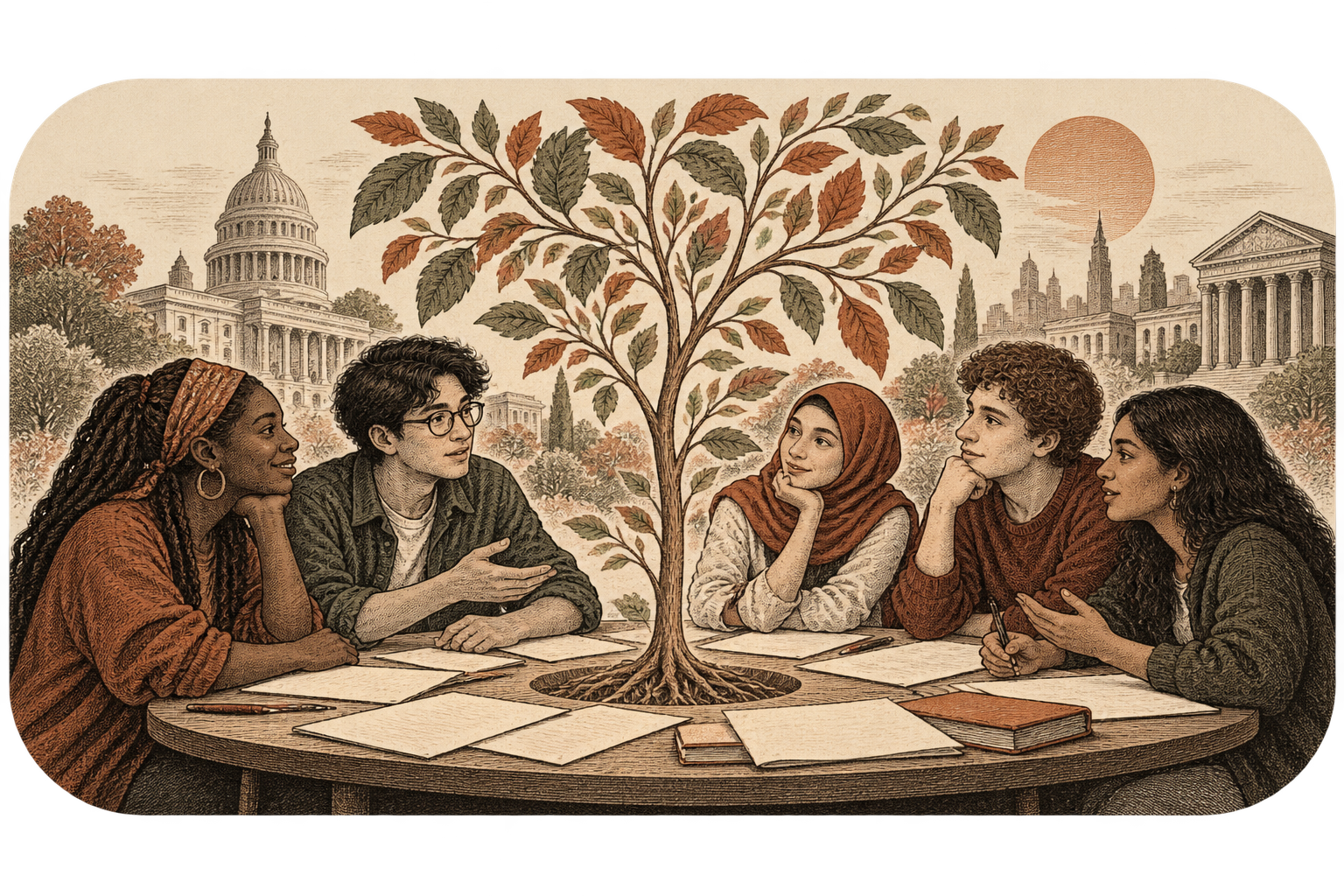
Young people are often invited to speak about the future. We are asked what worries us, what inspires us, and what kind of world we hope to inherit. We answer in classrooms, at conferences, through surveys, and on stages where someone has carefully allocated a few minutes for the youth perspective.
Then the meeting ends. The decisions move elsewhere.
This is where Youth for Sustainable Policy begins: with the distance between being heard and having influence.
We believe young people should help design the future, not just inherit it. That belief asks more of us than enthusiasm. It asks us to study problems carefully, make arguments that can withstand scrutiny, and remain involved when the work becomes slow or difficult. It also asks institutions to make room for contributions that can change a decision.
This manifesto sets out the commitments we want to bring to that work. We cannot speak for an entire generation. We can explain what we stand for, what we ask of the people writing the rules, and what we owe the communities those rules affect.
Give participation somewhere to go
An invitation is a beginning. Its value depends on what follows.
When young people contribute to a consultation, they should know which decisions remain open, who will consider their recommendations, and how they will learn what happened next. A process should be able to explain which proposals were accepted, which were rejected, and why.
We do not expect every suggestion to become policy. We expect contributions to receive serious consideration.
That requires clarity before participation begins. Is a discussion gathering ideas, reviewing an existing proposal, or helping decide between alternatives? What can participants reasonably influence? Who has the authority to act?
These questions make participation more honest. They also make it more useful. People can contribute better when they understand the problem, the constraints, and the purpose of their involvement.
Our request is straightforward: create a route from contribution to consideration, and make that route visible.
Make evidence accessible
Policy conversations can be difficult to enter. Technical language, unfamiliar institutions, and dense reports can leave people feeling that they need permission to ask a basic question.
Young people deserve opportunities to develop the knowledge that meaningful participation requires.
At YSP, we want research, storytelling, and policy dialogue to support one another. Research helps us examine a claim. Storytelling helps us understand how an issue is experienced. Dialogue allows people to test interpretations, challenge assumptions, and consider what might work.
Each has responsibilities. A compelling story should not carry a conclusion its evidence cannot support. A persuasive statistic needs context. A confident recommendation should explain its limitations.
We commit to asking where a claim comes from, what it measures, whose experience it captures, and what remains uncertain. When evidence changes, our position should be able to change with it.
Making knowledge accessible means preserving its complexity while helping more people engage with it.
Ask who carries the cost
Sustainability decisions reach into ordinary life: the journeys people take, the homes they live in, the work available to them, and the prices they pay.
A policy may have a worthwhile objective while placing difficult demands on people with little room to adapt. Someone working irregular hours may face different transport choices from someone with a predictable schedule. A household with limited savings may struggle to absorb an upfront cost, even when an investment promises long-term savings.
These differences belong inside the policy discussion.
We want sustainability proposals to explain who benefits, who pays, what support is available, and how difficulties will be identified after implementation. We want environmental goals considered alongside affordability, dignity, and practical access.
The people affected should have opportunities to shape the response. Their experience can reveal barriers that a well-written proposal overlooks.
A durable transition needs both a clear direction and a workable path for the people expected to follow it.
Build participation beyond the familiar faces
Youth leadership can become a small circle of people who already know how to enter the room.
Applications may reward polished writing, established networks, or previous leadership experience. Meetings may assume that participants have reliable internet, free evenings, confidence speaking English, or the money to travel.
Over time, those assumptions shape whose views become visible.
We want more routes into policy work: contributions that can be made remotely, clear introductory materials, smaller discussions, and opportunities for people who are still learning. Where resources allow, participation should account for costs, accessibility, and different time commitments.
We also need to listen beyond the people most comfortable speaking. Quietness does not tell us whether someone has insight. An unfamiliar vocabulary does not tell us whether someone understands a problem in their community.
Within YSP, we want to recognise careful research, translation, editing, coordination, and sustained support alongside public speaking and prominent titles. A contribution should matter because of the work it does.
Make responsibility traceable
Public commitments should give people enough information to assess progress.
When an institution announces a target, we want to understand its starting point, timeline, responsibilities, and measures of success. When progress falls short, we want an explanation that helps people judge what needs to change.
Youth organisations owe their communities the same discipline.
We should distinguish plans from completed work, audience reach from outcomes, and expressions of interest from established partnerships. We should credit the people who contribute and correct errors openly.
A small, documented achievement can teach us more than a large promise with no way to examine it.
For YSP, accountability means building habits that make our work reviewable: clear ownership, recorded decisions, transparent limitations, and opportunities for feedback. These habits matter before an organisation becomes large.
Learn to disagree productively
Policy involves competing priorities. People may share an environmental goal while disagreeing about the fairest or most effective way to pursue it.
We want space for those disagreements.
A useful discussion allows someone to question a recommendation without being treated as indifferent to the problem. It asks participants to explain their reasoning, engage with evidence, and consider consequences beyond their preferred outcome.
Young people need practice in this kind of discussion. We also need institutions willing to engage with questions that are inconvenient or unfinished.
Our responsibility is to arrive prepared and listen carefully. We should be able to describe an opposing argument fairly, acknowledge a valid criticism, and revise our own proposal.
The aim is a decision that people can understand, examine, and improve.
Stay after the announcement
Starting an initiative can feel exciting. Maintaining it requires a different kind of commitment.
Someone must check the references, follow up on unanswered questions, support a new contributor, record what was learned, and finish the work that attracted less attention than its announcement.
We want YSP to value that persistence.
Our ambition is to help young people become capable contributors to public life: people who can investigate a problem, work with others, explain a recommendation, and accept responsibility for its limits.
To the people writing the rules, we ask for meaningful access, clear feedback, and opportunities to contribute before decisions are settled.
To our peers, we ask for curiosity, care, and the patience to build knowledge before claiming authority.
The future is already taking shape through decisions made today. We want to understand those decisions, help improve them, and stay involved long enough to learn what they change.
That is the work we are committing to.
行胜于言 — actions speak louder than words.
Kim Mei Tong is the Founder and CEO of Youth for Sustainable Policy and President of BrainInk Magazine.